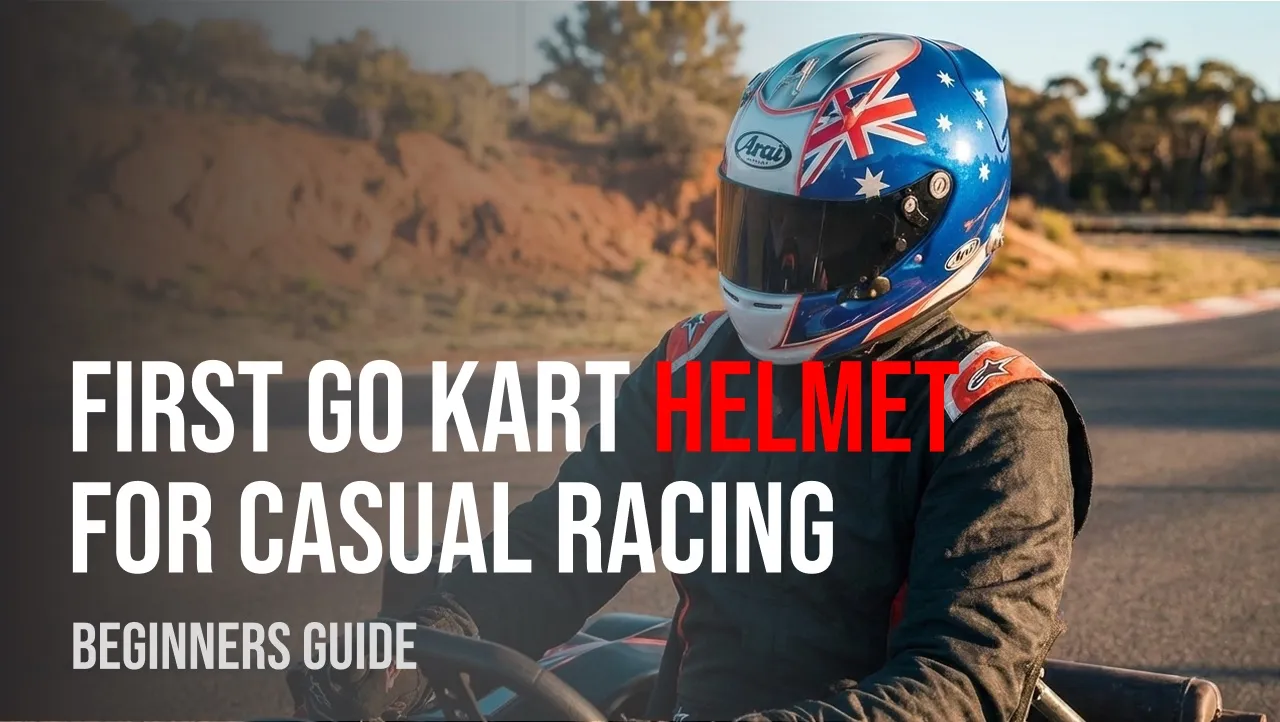
So you’ve been to the track a few times, you’re hooked on karting, and you’re thinking about getting your own helmet. Maybe the rental helmets never quite fit right, or you’re not thrilled about sharing headwear with dozens of strangers. Either way, buying your own helmet is a solid investment if you’re karting regularly.
Here’s the honest truth that might save you some money: for casual hire karting, you don’t need an expensive kart-specific helmet. A standard motorcycle helmet works perfectly fine, and that’s what most recreational karters use.
Motorcycle Helmets vs Karting Helmets
Let’s clear this up straight away. Kart-specific helmets exist, and they start around $350 for entry-level options, with decent ones running over $1,000. They’re designed for competitive racing with features like wider eye ports for peripheral vision, lighter weight, and fire-resistant materials.
But here’s the thing: if you’re doing hire karting on weekends, you don’t need any of that. You’re driving at 50-70km/h on a recreational track, not competing in a championship. A motorcycle helmet in the $100-150 range meets safety standards, protects your head, and does everything you need it to do.
Hire tracks accept motorcycle helmets without question. Look around next time you’re at one - most people with their own helmets are wearing motorcycle gear, not purpose-built karting helmets.
Save the expensive karting-specific gear for if you ever join a racing club or start competing. Until then, a motorcycle helmet is the smart choice.
Why Buy Your Own?
Even if you’re sticking with a budget motorcycle helmet, having your own beats rental gear for a few reasons.
Fit matters. Everyone’s head is shaped differently. Rental helmets come in generic sizes, so they’re either slightly loose or slightly tight. Your own helmet can fit perfectly, which means it won’t shift around during hard cornering and won’t give you a headache after twenty minutes.
Hygiene. Tracks clean their helmets, but you’re still sharing with hundreds of other people. If that bothers you, your own helmet solves it completely.
Comfort. No mysterious smells, worn-out padding, or scratched visors. Just a better experience overall.
What to Look For
For karting, you want a full-face helmet. This covers your entire head including your chin and jaw. Open-face helmets leave your lower face exposed, which isn’t ideal when you’re close to the ground with other karts around. Debris, bugs, and rubber from tyres are all good reasons for that chin bar.
Look for helmets with DOT or ECE certification. These are safety standards that ensure the helmet can actually protect you in an impact. Any decent helmet sold in Australia will meet these.
Removable and washable liners are a nice feature. After a few sweaty sessions, you’ll appreciate being able to pull out the padding and give it a wash.
Budget Options That Work
Here are some solid options in the $100-150 range that’ll serve you well at hire tracks:
- Vsenkes Full Face Helmet - Lightweight budget option, good starter helmet
- Modular Flip-Up Helmet - DOT/ECE approved, dual visor, handy flip-up design
- Full Face with Removable Liner - DOT/ECE, easy to keep clean
- Touring Style Helmet - Comfortable for longer sessions
- Classic Full Face - Simple, does the job
- Integrated Dual Visor - Built-in sun visor, DOT/ECE approved
- Street Racing Style - Sporty look, removable washable liner
- Motocross Style - If you like the off-road aesthetic
Any of these will work fine for hire karting. Pick one that fits your budget and style, make sure you get the right size, and you’re sorted.
Getting the Right Fit
A helmet should fit snugly without being painful. When you put it on, it should feel firm around your entire head, with the cheek pads pressing gently against your cheeks. You shouldn’t be able to slide it around or rotate it on your head. If you can, it’s too loose.
Shake your head side to side and up and down. The helmet should move with your head, not independently. It should sit level, not tilted back or forward.
Wear it for at least five minutes before deciding. A helmet that feels slightly tight at first often relaxes into a perfect fit as the padding adjusts. One that feels immediately comfortable might end up too loose once the padding compresses.
If ordering online, check the size chart carefully and measure your head. Most brands have slightly different sizing, so don’t assume your size in one brand matches another.
Looking After Your Helmet
Store it in a helmet bag when not using it. Keeps dust off, prevents scratches, and protects it from getting knocked around. A basic bag costs about $20 and is worth it.
Clean the visor with a soft cloth and water. Avoid household glass cleaners as some can damage the coating. For stubborn bugs, let a wet cloth sit on the spot for a few minutes to soften it before wiping.
If your helmet has a removable liner, pull it out and hand wash it occasionally. Let it air dry completely before putting it back.
Don’t drop your helmet on hard surfaces. Even if it looks fine, the impact-absorbing materials inside can be compromised. And keep it away from extreme heat - don’t leave it on your car dashboard on a hot day.
Time to Hit the Track
A $100-150 motorcycle helmet is all you need to get started. It’ll fit better than rentals, it’s yours to maintain how you like, and it’ll last years with basic care.
If you ever get serious about competitive karting and join a club, you can look into proper karting helmets then. But for having fun at hire tracks? Don’t overthink it. Grab a helmet that fits, and get out there.
Related reading: